

The eldritch things famous rationalists believed, doubted, and took seriously
God, spirit, telepathy, purpose, free will, and the limits of physics

At nineteen, while grieving, Alan Turing wrote that a spirit may find another body after death. In a mature published essay, he called the statistical evidence for telepathy “overwhelming,” though that evidence was later discredited.
Sigmund Freud urged his readers to think more kindly about thought-transference.
Bertrand Russell said that a five-minute “mystic illumination” transformed him for life, while also calling part of the experience delusive.
None of those above became a conventional “believer.” If you’re reading this, you most likely aren’t conventional either.
Of course, the famous names prove nothing by themselves.
Some were atheists who believed in objective value. Some were scientific skeptics who prayed. Some entertained telepathy while rejecting religion. Others thought physics was real but woefully incomplete.
What Does “Rationalist” Mean?
A note on the word rationalist. I use it broadly, for the scientists, mathematicians, skeptics, and analytic philosophers that we tend to file under the hardnosed analytic type: that is, the people we assume leave no room for God, spirit, or purpose.
A couple of the names here (Nietzsche, Marx) are no one’s idea of a rationalist but I’m including them anyway.
The entries below don’t all make the same sort of claim. Instead, they include settled beliefs, possibilities taken seriously, limits placed on science, religious language used without theism, dated phases, recollections, and even later-rejected positions.
Every entry below is tied to a primary text where one is accessible, or identified explicitly as a recollection, reported interview, translation, or later reconstruction. Where the surrounding context changes the apparent meaning, I’ve tried to include it.
The figures quoted are:
Nima Arkani-Hamed
A. J. Ayer
Hans Berger
Susan Blackmore
C. D. Broad
Georg Cantor
Rudolf Carnap
Nancy Cartwright
Noam Chomsky
Francis Crick
Charles Darwin
Richard Dawkins
John Dewey
Paul Dirac
Theodosius Dobzhansky
Ronald Dworkin
Freeman Dyson
John C. Eccles
Albert Einstein
Richard Feynman
Antony Flew
Sigmund Freud
Martin Gardner
Kurt Gödel
Stephen Jay Gould
Jürgen Habermas
J. B. S. Haldane
G. H. Hardy
Sam Harris
Harry Houdini
Fred Hoyle
Thomas Henry Huxley
Stuart Kauffman
Michael Levin
Karl Marx
Peter Medawar
John Stuart Mill
Iris Murdoch
Thomas Nagel
Isaac Newton
Friedrich Nietzsche
Wolfgang Pauli
Wilder Penfield
Roger Penrose
Max Planck
Karl Popper
Hilary Putnam
Srinivasa Ramanujan
Carl Rogers
George John Romanes
Bertrand Russell
Carl Sagan
Erwin Schrödinger
John Searle
Michael Shermer
Alan Turing
John von Neumann
Alfred Russel Wallace
Eugene Wigner
Edward Witten
Ludwig Wittgenstein
Sewall Wright
Nima Arkani-Hamed
“I’m an atheist ... I don’t believe in God. I do, however, think that instead of worshipping a vast and unknowable God, we can devote ourselves to this slow unveiling of the vastness of truth in all of its glory.”
Nima Arkani-Hamed, “The Morality of Fundamental Physics”, Cornell University, 21 April 2016, 04:26 and 1:19:19–1:20:31.
Context: Arkani-Hamed remains an atheist, as far as I know. His claim is that the pursuit of physical and mathematical truth can supply awe, meaning, and an invariant, rough sort of moral code, serving some functions religion has served without requiring belief in God.
A. J. Ayer
“My experiences have weakened, not my belief that there is no life after death, but my inflexible attitude towards that belief.”
A. J. Ayer, “Postscript to a Postmortem”, The Spectator, 15 October 1988, p. 13.
Context: Ayer was correcting his first report of a near-death experience. He remained an atheist and continued to believe death ended him. What changed was his certainty that the alternative deserved no serious consideration.
Hans Berger
“This is a case of spontaneous telepathy in which at a time of mortal danger ... I transmitted my thoughts, while my sister ... acted as the receiver.”
Hans Berger, Psyche (Jena: Gustav Fischer, 1940), pp. 5–6; trans. Pierre Gloor, Hans Berger on the Electroencephalogram of Man (Elsevier, 1969); quoted in Jonna Brenninkmeijer, “Brainwaves and psyches: A genealogy of an extended self”, History of the Human Sciences 28, no. 3 (2015): 115–133.
Context: The experience helped motivate Berger’s search for physical signs of psychic energy, which led to the first human EEG. EEG didn’t establish telepathy; Berger’s scientific discovery resulted from a causal interpretation that remains unsupported.
Susan Blackmore
“I nonetheless became convinced that my spirit, or soul, or astral body, had left my physical body …”
Susan Blackmore, “Solo Science: Going It Alone”, Intelligent Life, Autumn 2008, pp. 102–106.
Context: Blackmore is a reverse trajectory. A vivid out-of-body experience made her a paranormal believer and sent her into parapsychology. Repeated failures and methodological problems changed her mind. She later called the process an “anti-conversion” and became a leading skeptic.
C. D. Broad
“I should be slightly more annoyed than surprised if I should find myself in some sense persisting immediately after the death of my present body.”
C. D. Broad, Lectures on Psychical Research, 1962, p. 430; passage indexed by the Society for Psychical Research.
Context: Broad was a religious skeptic and one of Cambridge’s leading analytic philosophers. He regarded survival as a serious possibility, not an established fact.
Georg Cantor
“I entertain no doubts as to the truth of the transfinites, which I have recognized with God’s help and which, in their diversity, I have studied for more than twenty years.”
“But now I thank God, the all-wise and all-good, that He always denied me the fulfillment of this wish ... for He thereby constrained me, through a deeper penetration into theology, to serve Him and His Holy Roman Catholic Church better than I have been able with my exclusive preoccupation with mathematics.”
Georg Cantor, letters to Ignatius Jeiler (Whitsuntide 1888) and to Charles Hermite (January 1894), translated in Joseph W. Dauben, Georg Cantor: His Mathematics and Philosophy of the Infinite, Harvard University Press, 1979, p. 147; his correspondence with Cardinal Franzelin on the Absolute Infinite is at p. 145.
Context: These are Cantor’s own words, from his letters, and they express a settled lifelong conviction rather than a passing remark. He believed transfinite set theory had been shown to him “with God’s help,” corresponded for years with Catholic theologians, and at times cast himself as God’s reporter. He was careful, though, to separate the two infinities: the Absolute Infinite he reserved for God alone, while his transfinite numbers were created and mathematical, a distinction he used to answer Cardinal Franzelin’s worry that the theory verged on pantheism. His theology was his motivation and his metaphysics, not his proof; set theory is accepted today on mathematical grounds, wholly independent of the beliefs that inspired it.
Rudolf Carnap
“The question of the existence and explanation of the alleged parapsychological phenomena was an important scientific problem.”
Rudolf Carnap, “Intellectual Autobiography”, in Paul Arthur Schilpp, ed., The Philosophy of Rudolf Carnap, Open Court, 1963, p. 25.
“We ... defended the right to examine objectively and scientifically all processes or alleged processes.”
Carnap, “Intellectual Autobiography,” pp. 22–23.
Context: Carnap withheld belief in séances and spirits. The architect of logical empiricism defended parapsychology as an intelligible empirical question rather than dismissing it by definition.
Nancy Cartwright
“For all we know, most of what occurs in nature occurs by hap, subject to no law at all.”
Nancy Cartwright, The Dappled World: A Study of the Boundaries of Science, Cambridge University Press, 1999, p. 1.
“The laws that describe this world are a patchwork, not a pyramid.”
Cartwright, The Dappled World, p. 1.
Context: Cartwright accepts science while denying the inference from physics succeeding in specially organized domains to physics universally governing everything in one closed deductive system.
Noam Chomsky
“My hunch ... is that the answer to the riddle of free will lies in the domain of potential science that the human mind can never master.”
Noam Chomsky, “Things No Amount of Learning Can Teach”, interview with John Gliedman, Omni, November 1983.
“We have a body of scientific knowledge that simply doesn’t appear to connect with the problem of free will in any way.”
Chomsky, “Things No Amount of Learning Can Teach”.
Context: Chomsky appeals to neither a soul nor quantum indeterminacy. His stranger claim is that free will may have a scientific explanation that human cognitive architecture makes permanently inaccessible to us.
Francis Crick
“How it will all turn out remains to be seen. The Astonishing Hypothesis may be proved correct. Alternatively, some view closer to the religious one may become more plausible.”
Francis Crick, The Astonishing Hypothesis: The Scientific Search for the Soul, Scribner, 1994, p. 263.
Context: Crick’s book argues that mental life depends on neuronal activity. He continued by allowing a third possibility: a new view unlike both crude materialism and religion. This is a statement of falsifiability, not evidence that he privately rejected his own hypothesis. In a 1973 Icarus paper with Leslie Orgel and in his 1981 book Life Itself, Crick also floated ‘directed panspermia,’ the hypothesis that the first microorganisms may have been deliberately sent to Earth by an advanced extraterrestrial civilization; he offered it as a serious if avowedly speculative conjecture prompted by the difficulty of explaining life’s origin, stressing that the evidence could not yet judge it.
Charles Darwin
“When thus reflecting I feel compelled to look to a First Cause having an intelligent mind ... and I deserve to be called a Theist.”
Charles Darwin, The Autobiography of Charles Darwin 1809–1882, restored ed. Nora Barlow, 1958, pp. 92–93.
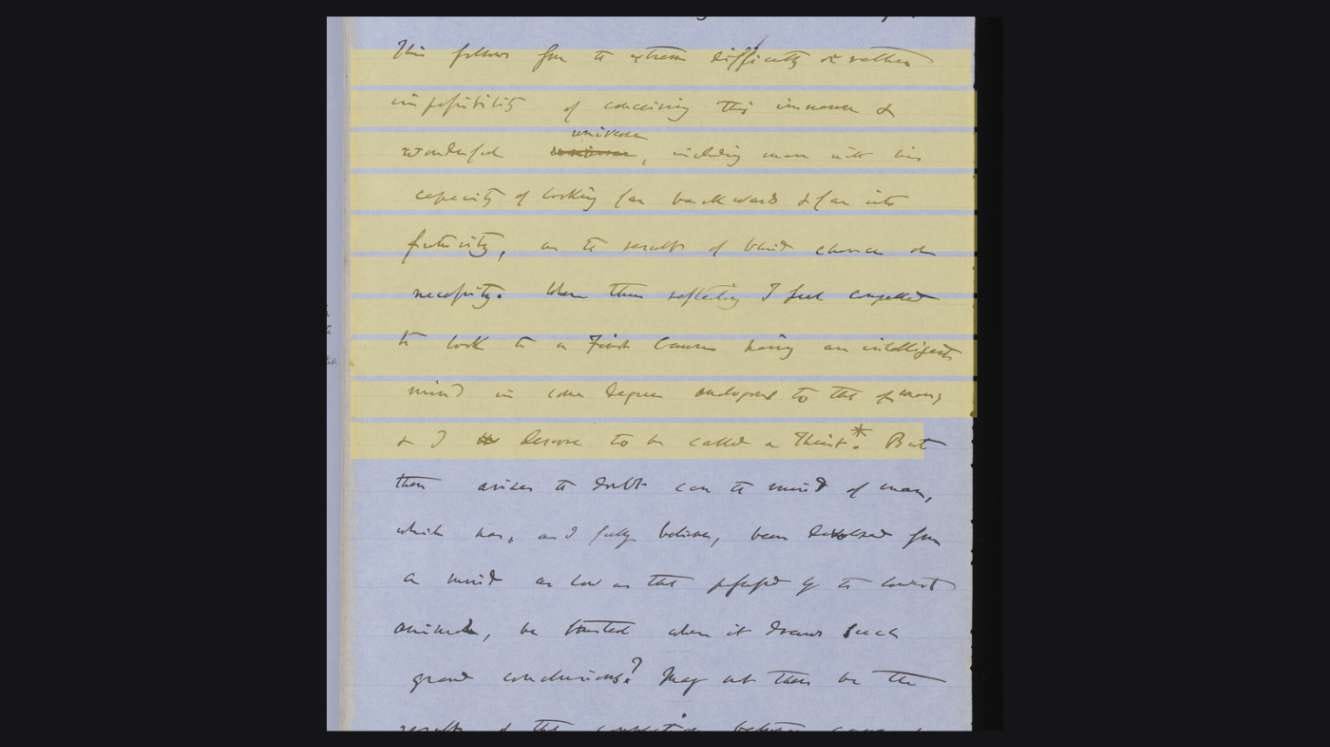
“This conclusion was strong in my mind about the time, as far as I can remember, when I wrote the Origin of Species.”
Darwin, Autobiography, p. 93.
Context: Darwin immediately says this conviction gradually weakened. Late in life he generally described himself as agnostic. The quotation documents a position he held near the writing of Origin, not his final verdict.
Richard Dawkins
“We, alone on earth, can rebel against the tyranny of the selfish replicators.”
Richard Dawkins, The Selfish Gene, Oxford University Press, 1976, concluding sentence of the first edition.
“As an academic scientist I am a passionate Darwinian ... I am a passionate anti-Darwinian when it comes to politics and how we should conduct our human affairs.”
Richard Dawkins, A Devil’s Chaplain, Houghton Mifflin, 2003, title essay.
Context: Dawkins insists our capacity to rebel against our genetic programming is itself a human achievement. He rejects the idea that evolutionary explanation determines human value or tells us what we ought to become.
John Dewey
“One reason why personally I think it fitting to use the word ‘God’ to denote that uniting of the ideal and actual ... lies in the fact that aggressive atheism seems to me to have something in common with traditional supernaturalism.”
John Dewey, A Common Faith, Yale University Press, 1934, pp. 51–52.
Context: Dewey rejected supernatural theism. He nevertheless defended religious experience and deliberately retained “God” for the active union of ideal possibilities with actual human life.
Paul Dirac
“One could perhaps describe the situation by saying that God is a mathematician of a very high order.”
Paul Dirac, “The Evolution of the Physicist’s Picture of Nature”, Scientific American 208, no. 5, May 1963, pp. 45–53.
Context: Dirac was famously hostile to religion. The opening qualifier matters: this is his metaphor for the extraordinary mathematical order of physical theory, not a confession of theism.
Theodosius Dobzhansky
“I am a creationist and an evolutionist. Evolution is God’s, or Nature’s method of creation.”
Theodosius Dobzhansky, “Nothing in Biology Makes Sense Except in the Light of Evolution”, The American Biology Teacher 35, no. 3, 1973, p. 129.
Context: Dobzhansky was raised in the Russian Orthodox tradition and remained religious throughout his life, though his student and biographer Francisco Ayala records that he rejected belief in a personal God and in an afterlife. He was a central architect of the modern evolutionary synthesis. His “creationism” meant ongoing theistic evolution, not young-earth creationism or rejection of common descent.
Ronald Dworkin
“Religion, we should say, does not necessarily mean a belief in God.”
Ronald Dworkin, “Religion Without God”, The New York Review of Books, 4 April 2013.
“The religious attitude accepts the full, independent reality of value.”
Dworkin, “Religion Without God.”
“…human life has objective meaning or importance.”
Dworkin, “Religion Without God.”
Context: Dworkin was an atheist. He used “religious” for commitment to objective value, the intrinsic importance of a life lived well, and the sublimity of nature.
Freeman Dyson
“I claim that paranormal phenomena may really exist but may not be accessible to scientific investigation.”
Freeman Dyson, “One in a Million”, The New York Review of Books, 25 March 2004.
Context: Dyson accepted that controlled attempts to establish telepathy and ESP had failed. He called real but scientifically inaccessible paranormal phenomena a hypothesis, said he was not claiming it was true, and judged it tenable and plausible. His proposed incompatibility between strong emotion and controlled testing was speculation, not an experimental result.
John C. Eccles
“I maintain that the human mystery is incredibly demeaned by scientific reductionism, with its claim in promissory materialism to account eventually for all of the spiritual world in terms of patterns of neuronal activity.”
John C. Eccles, Evolution of the Brain: Creation of the Self, Routledge, 1989, p. 241.
Context: Eccles won the Nobel Prize for discovering how signals cross the synapse, and here the working neurophysiologist argues that reductive materialism cannot account for the unified conscious self. “Promissory materialism,” a phrase from his long collaboration with Karl Popper, names the IOU that neuroscience will eventually explain all of mind in neural terms; Eccles called believing it a superstition. His own dualist alternative, a non-material self that acts on the brain, has little support among today’s neuroscientists, while the explanatory gap he pressed remains a live problem. He is marking a limit of reduction, not claiming to have located a soul.
Albert Einstein
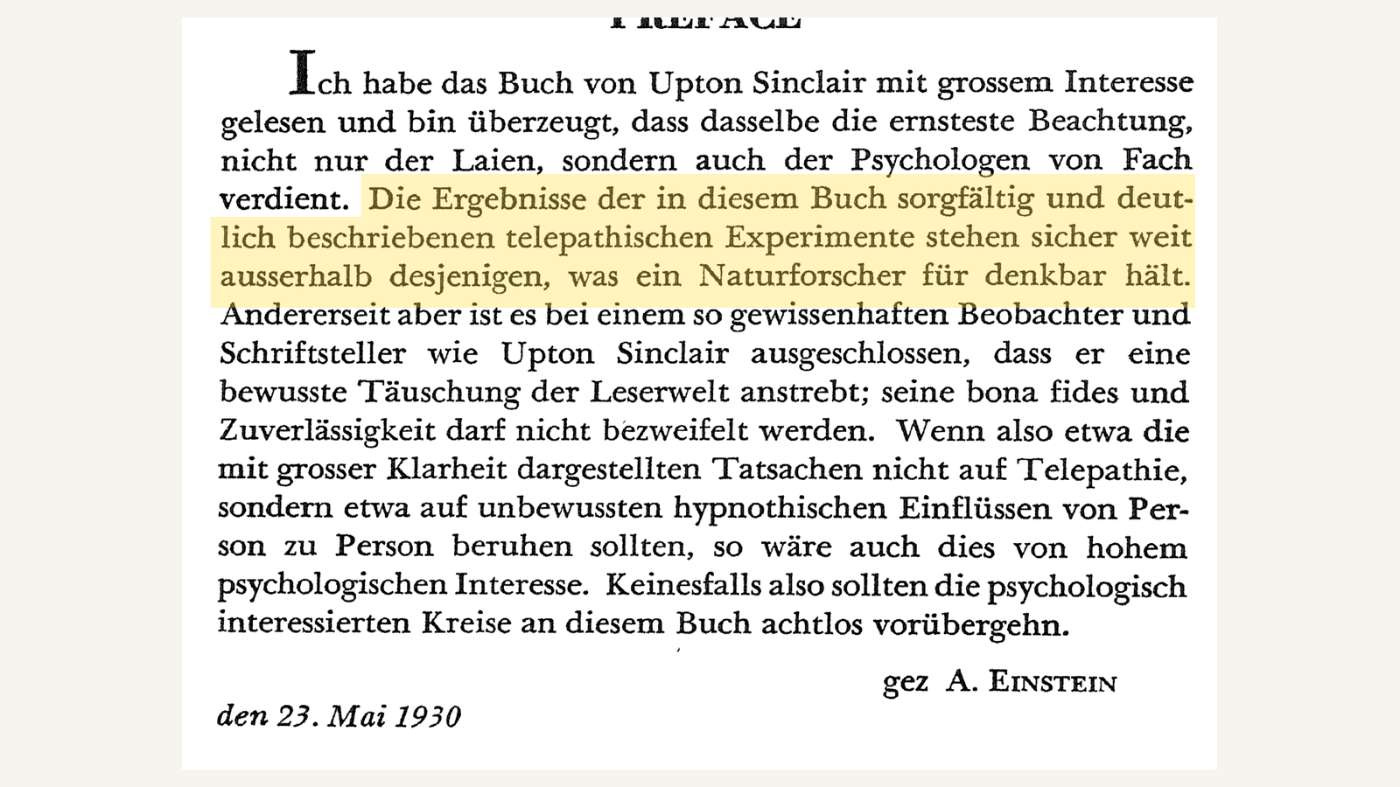
“The results of the telepathic experiments ... stand surely far beyond those which a nature investigator holds to be thinkable.”
Albert Einstein, preface to Upton Sinclair, Mental Radio, 1930, p. ix.
“I did it without revealing my lack of conviction ... I admit frankly my skepticism in respect to all such beliefs and theories.”
Einstein, letter to Jan Ehrenwald, 13 May 1946; reproduced with permission of the Einstein estate in Martin Gardner, “Einstein and ESP,” The Zetetic, Fall/Winter 1977, p. 55.
Context: Einstein supplied the 1930 preface from friendship and later clarified that it concealed his lack of conviction. The pair shows how an authentic quotation can imply a belief the speaker denied holding.
Richard Feynman
“I can find no better expression of my beliefs of morality ... than is in that encyclical.”
Feynman, The Meaning of It All, Perseus, 1998, lecture 3, discussing Pope John XXIII’s Pacem in Terris.
Context: Feynman didn’t accept the encyclical’s divine grounding. He still considered conventional religious belief logically consistent with science and thought a papal text expressed his morality better than anything else he knew.
There’s also this one below from Feynman:
Western civilization, it seems to me, stands by two great heritages. One is the scientific spirit of adventure – the adventure into the unknown, an unknown which must be recognized as being unknown in order to be explored; the demand that the unanswerable mysteries of the universe remain unanswered; the attitude that all is uncertain; to summarize it – the humility of the intellect. The other great heritage is Christian ethics – the basis of action on love, the brotherhood of all men, the value of the individual – the humility of the spirit.
These two heritages are logically, thoroughly consistent. But logic is not all; one needs one’s heart to follow an idea. If people are going back to religion, what are they going back to? Is the modern church a place to give comfort to a man who doubts God‑more, one who disbelieves in God? Is the modern church a place to give comfort and encouragement to the value of such doubts? So far, have we not drawn strength and comfort to maintain the one or the other of these consistent heritages in a way which attacks the values of the other? Is this unavoidable? How can we draw inspiration to support these two pillars of western civilization so that they may stand together in full vigor, mutually unafraid? Is this not the central problem of our time?
Antony Flew
“The case for an Aristotelian God who has the characteristics of power and also intelligence, is now much stronger than it ever was before.”
Antony Flew, interview with Gary Habermas, “My Pilgrimage from Atheism to Theism”, Philosophia Christi 6, no. 2, 2004, pp. 197–211.
Context: Flew had spent half a century as one of philosophy’s most prominent defenders of atheism. His late position was deism, not Christianity: he continued to reject revelation, resurrection, divine moral governance, and personal survival. Later coauthored presentations of his conversion generated legitimate concerns about assistance and declining health, so this entry rests on his direct 2004 interview rather than the 2007 book.
Sigmund Freud
“I must urge you to have kindlier thoughts on the objective possibility of thought-transference and at the same time of telepathy as well.”
Sigmund Freud, “Dreams and Occultism,” New Introductory Lectures on Psycho-Analysis, lecture XXX, trans. James Strachey, Standard Edition vol. 22, 1964, pp. 54–55.
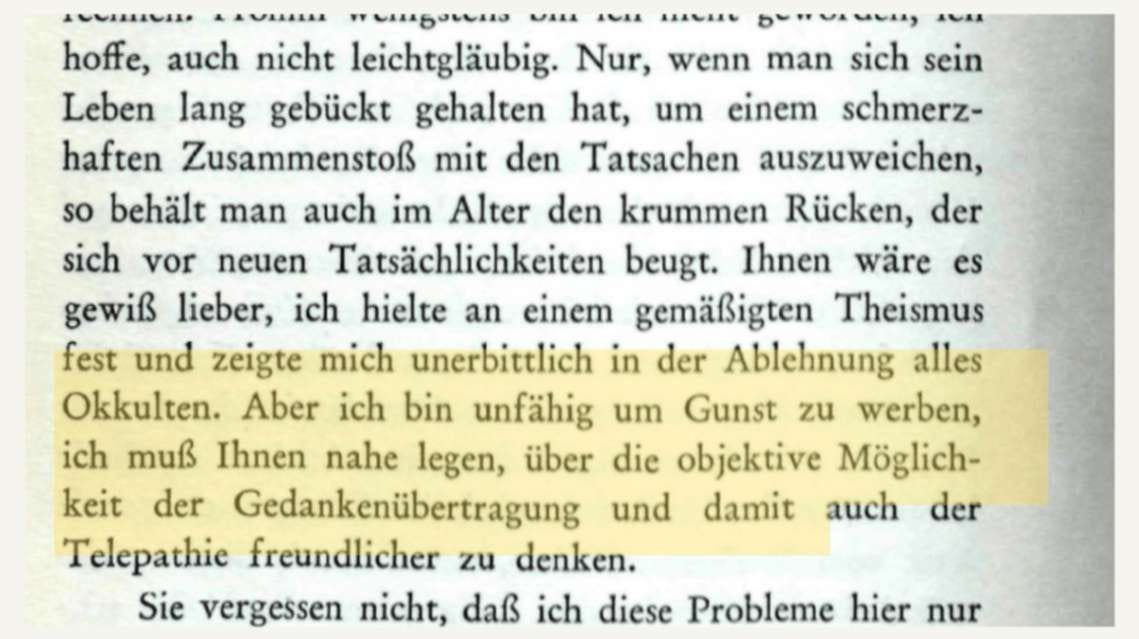
Freud described his position as not being entirely convinced but prepared to be convinced.
Freud, “Dreams and Occultism.”
Context: Freud dismissed most occult reports and imagined telepathy, if real, as an unknown natural process. But he didn’t dismiss thought-transference as impossible or merely fraudulent.
Martin Gardner
“I believe in a personal god, and I believe in an afterlife, and I believe in prayer, but I don’t believe in any established religion.”
Martin Gardner, Cambridge University Press interview, 2008.
“There’s no empirical evidence for it, and no logical proof, but the possibility is open.”
Gardner, Cambridge University Press interview, discussing survival after death.
Context: Gardner spent much of his career exposing pseudoscience and paranormal fraud. He described his theism as hope and faith, conceded that atheists had stronger arguments, and claimed no evidence for his belief.
Kurt Gödel
“My theory is rationalistic, idealistic, optimistic, and theological.”
Kurt Gödel, recorded by Hao Wang in A Logical Journey: From Gödel to Philosophy, MIT Press, 1996, pp. 8–9.
“My own religion is more similar to the religion of the churches.”
Gödel, recorded by Wang, A Logical Journey, pp. 152–153.
“If the world is rationally constructed and has meaning, then there must be such a thing [as an afterlife] ... But I am convinced of this, independently of any theology.”
Gödel, letter to his mother Marianne, 23 July 1961, translated in Wang, A Logical Journey, pp. 105–108; discussed in “Why Gödel Believed in the Afterlife”.
Context: The first two statements are Hao Wang’s notes of private conversations rather than Gödel’s published philosophy. The afterlife passage comes from Gödel’s own private letter to his mother. These are genuine theological commitments, but they do not follow from his incompleteness theorems. Separately, Gödel worked out a formal modal-logic proof of God’s existence, a modern revival of the Anselm and Leibniz ontological argument, which he kept private, showed to the logician Dana Scott in 1970, and which appeared in print only after his death in his Collected Works, Vol. III (Oxford University Press, 1995); it was a deliberate exercise in logic.
Stephen Jay Gould
“Science simply cannot ... adjudicate the issue of God’s possible superintendence of nature. We neither affirm nor deny it; we simply can’t comment on it as scientists.”
Stephen Jay Gould, “Impeaching a Self-Appointed Judge,” Scientific American 267, no. 1, July 1992, pp. 118–121; developed in “Nonoverlapping Magisteria”, 1997.
Context: Gould was an agnostic. His controversial NOMA principle assigned empirical facts to science and questions of ultimate meaning and moral value to religion and the humanities. Richard Dawkins explicitly rejected this division.
Jürgen Habermas
Secular society “need not cut itself off from the important resources of spiritual explanations.”
Jürgen Habermas, “Faith and Knowledge”, Peace Prize of the German Book Trade address, 14 October 2001.
The secular side should “retain a feeling for the articulative power of religious discourse.”
Habermas, “Faith and Knowledge.”
Context: Habermas remained a postmetaphysical thinker and methodological atheist. He argued that secular reason may lose moral meanings if it refuses to learn from religious language.
J. B. S. Haldane
“It seems to me immensely unlikely that mind is a mere by-product of matter.”
J. B. S. Haldane, “When I Am Dead”, Possible Worlds and Other Essays, 1927, pp. 209–210.
“It seems to me quite as probable that it will lose its limitations and be merged into an infinite mind ... which I have reason to suspect probably exists behind nature.”
Haldane, “When I Am Dead,” pp. 209–210.
“The data of the mystical consciousness can usefully supplement those of the mind in its normal state.”
Haldane, “Possible Worlds”, p. 286.
Context: Haldane rejected most mediumistic testimony and remained agnostic about personal survival. He also thought materialism, Christianity, theosophy, and Kantianism were all too simple.
G. H. Hardy
“I believe that mathematical reality lies outside us, that our function is to discover or observe it.”
G. H. Hardy, A Mathematician’s Apology, Cambridge University Press, 1940, section 22.
Context: Hardy was a combative atheist. His mathematical Platonism affirms a nonphysical domain that mathematicians discover rather than invent; it makes no theistic claim.
Sam Harris
“There is more to understanding the human condition than science and secular culture generally admit.”
Sam Harris, Waking Up: A Guide to Spirituality Without Religion, Simon & Schuster, 2014, chapter 1.
“Jesus, the Buddha, Lao Tzu, and the other saints and sages of history had not all been epileptics, schizophrenics, or frauds.”
Harris, Waking Up, chapter 1.
Context: Harris continued to condemn religious doctrines he considered false. His concession is experiential: contemplative traditions may contain important psychological truths that ordinary secular culture overlooks.
Harry Houdini
“I too would have parted gladly with a large share of my earthly possessions for the solace of one word from my loved departed ...”
“... after twenty-five years of ardent research and endeavor I declare that nothing has been revealed to convince me that intercommunication has been established between the Spirits of the departed and those still in the flesh.”
Harry Houdini, A Magician Among the Spirits, Harper & Brothers, 1924, Introduction.
Context: Houdini is a reverse trajectory. Grief drew him toward the séance room, above all the hope of hearing from his adored late mother, and he publicly offered rewards to any medium who could produce a genuine phenomenon under test. After roughly twenty-five years of investigation he concluded that every medium he examined was fraudulent. He did not claim to have proven survival impossible, only that nothing in his long inquiry had established contact with the dead; the openness and the verdict both belong on the record.
Fred Hoyle
“A common sense interpretation of the facts suggests that a superintellect has monkeyed with physics, as well as with chemistry and biology.”
Fred Hoyle, “The Universe: Past and Present Reflections”, Engineering and Science 45, no. 2, November 1981, p. 12.
Context: Hoyle’s inference combined nuclear fine-tuning with his heterodox ideas about cosmic life and panspermia. He did not become a Christian, and his biological claims were not accepted by mainstream science. The surprise is that an atheist astronomer inferred a superintellect, not that physics established one.
Thomas Henry Huxley
How consciousness arises from irritated nervous tissue “is just as unaccountable as the appearance of the Djin when Aladdin rubbed his lamp.”
Thomas Henry Huxley, Lessons in Elementary Physiology, Macmillan, 1866, p. 193.
Context: “Darwin’s bulldog” later removed the Djin comparison but retained the substantive claim that consciousness was as unaccountable as any ultimate fact of nature. The analogy marks an explanatory gap, not belief in supernatural beings.
Stuart Kauffman
“With agency came values, meaning, and doing, all of which are as real in the universe as particles in motion.”
Stuart Kauffman, Reinventing the Sacred, Basic Books, 2008, preface, pp. ix–xi.
“A couple in love walking along the banks of the Seine are, in real fact, a couple in love ... not mere particles in motion.”
Kauffman, Reinventing the Sacred.
Context: Kauffman rejects a creator God and proposes a natural sacred. His claim is that agency, value, and meaning are objectively real emergent features that are not replaced by particle descriptions.
Michael Levin
“I actually think that the Platonic view is more correct ... I think it’s a space of minds as well.”
Michael Levin, “Consciousness, Universal Mind, Emergence”, Theories of Everything, 16:57 and 18:04.
“The hardware does not define you.”
Levin, same interview, 37:07.
Context: Levin identifies the Platonic proposal as personal speculation, not an experimental conclusion. His laboratory claims are narrower: goals, memory, and problem-solving occur at biological scales where molecular description alone is predictively unhelpful.
Karl Marx
“Religion is the sigh of the oppressed creature, the heart of a heartless world, and the soul of soulless conditions.”
Karl Marx, “A Contribution to the Critique of Hegel’s Philosophy of Right: Introduction”, 1844.
“Religious suffering is, at one and the same time, the expression of real suffering and a protest against real suffering.”
Marx, “Critique of Hegel’s Philosophy of Right.”
Context: Marx proceeds to call religion the opium of the people and demands the abolition of illusory happiness. The often-omitted sentences show that he also understood religion as consolation, moral protest, and the displaced human heart of an inhuman world.
Peter Medawar
“Scientists do not speak on religion from a privileged position except insofar as those with a predilection for the Argument from Design have better opportunities than laymen to see the grandeur of the natural order of things, whatever they may make of it.”
Peter Medawar, Advice to a Young Scientist, Harper & Row, 1979, p. 31.
“That there is indeed a limit upon science is made very likely by the existence of questions that science cannot answer and that no conceivable advance of science would empower it to answer.”
Peter Medawar, The Limits of Science, Harper & Row, 1984, pp. 59–60.
Context: Medawar’s examples included “What are we all here for?” and “What is the point of living?” The Nobel immunologist was a hard rationalist who often attacked theology and pseudoscience. Yet he thought treating questions of meaning as scientific pseudoquestions discredited science.
John Stuart Mill
“…the adaptations in Nature afford a large balance of probability in favour of creation by intelligence.”
John Stuart Mill, Three Essays on Religion, “Theism,” Henry Holt, 1874, p. 174.
“Whatever else may be taken away from us by rational criticism, Christ is still left; a unique figure …”
Mill, Three Essays on Religion, p. 253.
Context: Mill called the design inference only probable and thought evolutionary explanation could weaken it. His praise of Christ concerns moral originality, not divinity, miracles, or resurrection.
Iris Murdoch
Prayer is “properly not petition, but simply an attention to God which is a form of love.”
Iris Murdoch, The Sovereignty of Good, “On ‘God’ and ‘Good’,” Routledge, 1970, p. 55.
“I shall suggest that God was (or is) a single perfect transcendent non-representable and necessarily real object of attention.”
Murdoch, The Sovereignty of Good, p. 55.
Context: Murdoch rejected conventional theism. She wanted a secular moral life oriented toward a real, transcendent Good and modeled moral attention partly on prayer.
Thomas Nagel
“I want atheism to be true ... It’s that I hope there is no God!”
Thomas Nagel, The Last Word, Oxford University Press, 1997, pp. 130–131.
“I believe this is one manifestation of a fear of religion which has large and often pernicious consequences for modern intellectual life.”
Nagel, The Last Word, pp. 130–131.
Nature may contain “principles of the growth of order” that are “teleological rather than mechanistic.”
Thomas Nagel, Mind and Cosmos, Oxford University Press, 2012, introduction.
Context: Nagel remains an atheist. His point is that emotional resistance to cosmic authority can bias atheists just as desire for God can bias believers. His teleology explicitly rejects divine intervention.
Isaac Newton
“That gravity should be innate, inherent and essential to matter, so that one body may act upon another at a distance through a vacuum, without the mediation of any thing else ... is to me so great an absurdity that I believe no man who has in philosophical matters any competent faculty of thinking can ever fall into it.”
Isaac Newton, letter to Richard Bentley, 25 February 1692/3; The Newton Project, THEM00258.
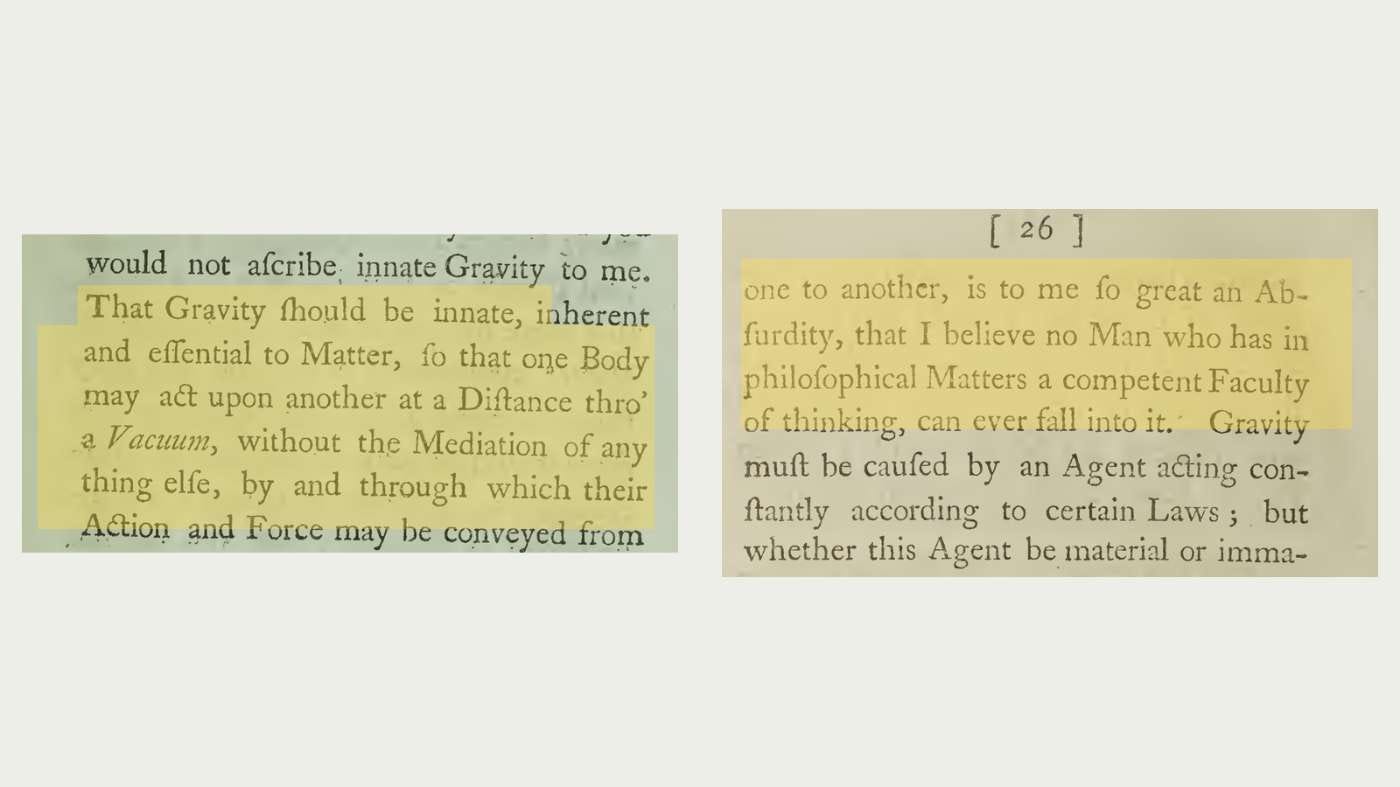
Context: Newton is doubting his own theory, not abandoning it. His mathematics of gravitation stood, but he found it philosophically absurd that inert matter could act across empty space with nothing to carry the force between bodies, and he explicitly left open whether the cause was “material or immaterial.” A devout though heterodox anti-Trinitarian, he suspected a non-mechanical cause; later physics answered the puzzle differently, first with fields and then with general relativity’s curved spacetime. The passage records a great physicist’s unease about the foundations of his own success, not a claim that gravity requires the supernatural.
Friedrich Nietzsche
“If one had the smallest vestige of superstition left in one, it would hardly be possible completely to set aside the idea that one is the mere incarnation, mouthpiece, or medium of an almighty power. The idea of revelation ... describes the simple fact.”
Friedrich Nietzsche, Ecce Homo, trans. Anthony M. Ludovici, “Thus Spake Zarathustra,” section 3, written 1888, p. 102.
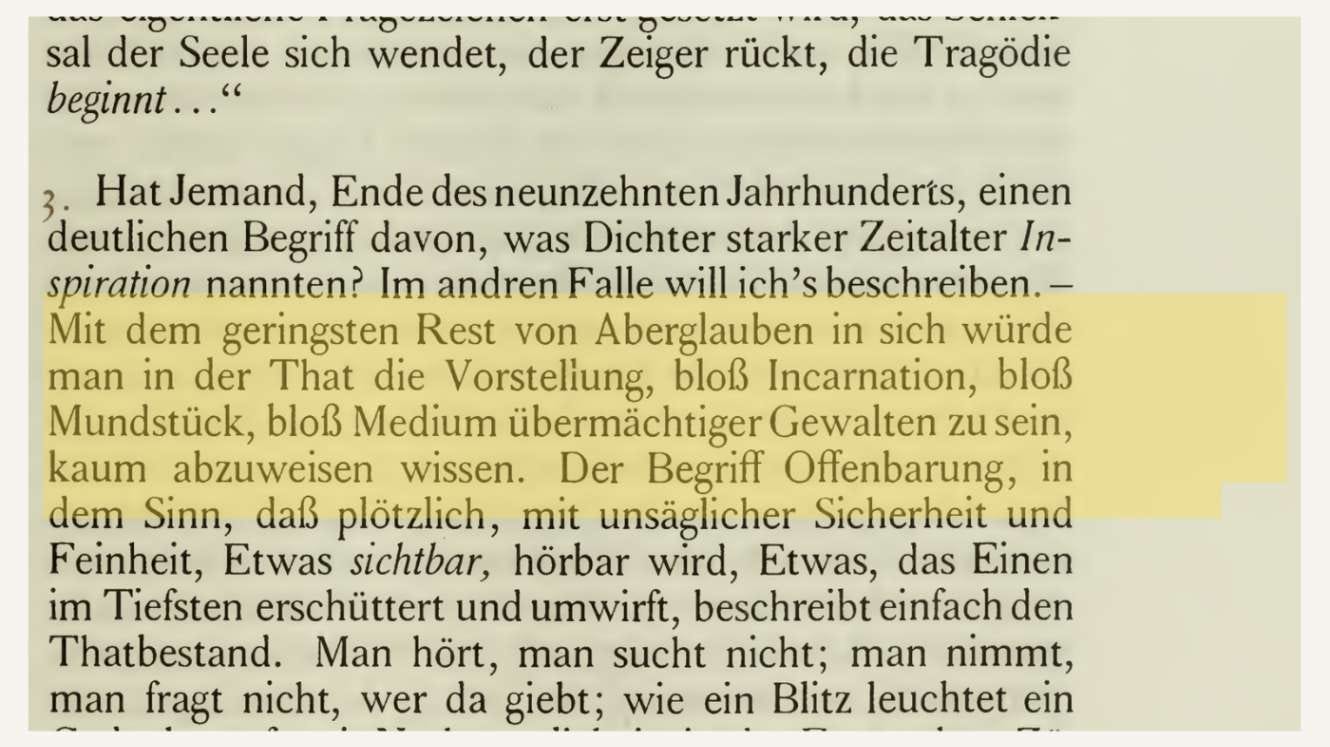
Context: Nietzsche is describing the involuntary, ecstatic experience of composing Thus Spoke Zarathustra. “Revelation” is phenomenological language, not a claim that God dictated the work. Ecce Homo is also intentionally hyperbolic.
Wolfgang Pauli
“It would be most satisfactory of all if physis and psyche could be seen as complementary aspects of the same reality.”
Wolfgang Pauli, “The Influence of Archetypal Ideas on the Scientific Theories of Kepler”, in C. G. Jung and Wolfgang Pauli, The Interpretation of Nature and the Psyche, trans. Priscilla Silz, 1955, p. 209.
Context: Pauli spent decades corresponding with Carl Jung about dreams, archetypes, synchronicity, and a possible common ground of mind and matter. He was exploring a dual-aspect picture, not claiming that quantum mechanics proves Jungian psychology. Colleagues also spoke, half in jest, of the ‘Pauli effect,’ his reputation for making laboratory equipment fail simply by being near it; the experimentalist Otto Stern is said to have barred him from his lab over it, and Pauli, rather than only laughing it off, was willing to read such coincidences as instances of the acausal ‘synchronicity’ he studied with Jung.
Wilder Penfield
“Throughout my own scientific career I ... struggled to prove that the brain accounts for the mind. But now ... Do brain-mechanisms account for the mind?”
Wilder Penfield, The Mystery of the Mind, Princeton University Press, 1975, p. xiii.
Context: The pioneer of cortical mapping concluded that materialist monism remained an unproved hypothesis and that dualism deserved serious consideration. He didn’t claim that cortical stimulation had detected a soul.
Roger Penrose
“I think I would say that the universe has a purpose. It’s not somehow just there by chance ... I think that there is something much deeper about it.”
Roger Penrose, interviewed in Errol Morris’s documentary A Brief History of Time (1991); transcript in Stephen Hawking, A Brief History of Time: A Reader’s Companion, Bantam, 1992.
Context: Penrose has also said that he isn’t a believer and accepts no established religion. His deliberately open use of “purpose” doesn’t endorse a creator God.
Max Planck
“I regard consciousness as fundamental. I regard matter as derivative from consciousness. We cannot get behind consciousness.”
Max Planck, interview with J. W. N. Sullivan, “Interviews with Great Scientists, No. VI: Max Planck,” The Observer (London), 25 January 1931, p. 17.
Context: This comes from a newspaper interview, not from Planck’s physics, and nothing in quantum theory establishes it. The founder of quantum theory, and a lifelong theist who denied belief in a personal God, is stating a personal idealist metaphysics in which mind is prior to matter, closer to Berkeley or to Schrödinger’s Vedanta than to any laboratory result. It is a conviction about the starting point of all description, not a claim that observers create reality or that experiments have found consciousness inside matter. The widely circulated 1944 “Das Wesen der Materie” speech that pins a “conscious and intelligent Mind” behind all matter is a separate text the Max Planck Society’s own archive judges inauthentic, and this entry does not rest on it.
Karl Popper
“Indeterminism and free will have become part of the physical and biological sciences.”
Karl Popper, A World of Propensities, Thoemmes, 1990, pp. 17–18.
Context: Popper regarded determinism as an ideology and reality as objectively open. Indeterminism alone does not establish libertarian freedom; his conclusion depends on a broader account of propensities, emergence, and mental causation. That broader account is developed in The Self and Its Brain: An Argument for Interactionism (Springer, 1977), written with the Nobel-winning neurophysiologist John Eccles, in which Popper defends a mind-body interactionism and a self that acts on but is not reducible to the brain, and introduces the label ‘promissory materialism’ for the rival view that neuroscience will eventually explain the mind away.
Hilary Putnam
“I do believe in the reality of spiritual experience.”
Hilary Putnam, interview with Rachel Bayefsky and Erin Miller, The Yale Philosophy Review 5, 2009, pp. 91–99.
“It is a vision that illuminates my life and my way of experiencing the world. That’s not a theoretical vision. Theoretically I’m a naturalist.”
Putnam, The Yale Philosophy Review interview.
Context: Putnam was a practicing Jew who rejected God as a First Cause, rejected religious foundations for ethics, and didn’t believe in an afterlife. He distinguished lived spiritual reality from explanatory metaphysics.
Srinivasa Ramanujan
“An equation for me has no meaning unless it expresses a thought of God.”
Srinivasa Ramanujan, reported remark to a friend, quoted in Robert Kanigel, The Man Who Knew Infinity: A Life of the Genius Ramanujan, Charles Scribner’s Sons, 1991; first recorded in S. R. Ranganathan, Ramanujan: The Man and the Mathematician, Asia Publishing House, 1967, p. 88.
Context: This is a reported saying, recalled by a friend and recorded in Ranganathan’s 1967 biography rather than written by Ramanujan, and it was said to a friend, not to Hardy, as dramatizations often imply. Ramanujan was sincerely devout and credited his family goddess, Namagiri of Namakkal, with revealing formulas to him in dreams. Yet Hardy, the atheist who knew his mathematics best, judged him closer to agnostic in actual belief and called him “no mystic”; later scholars note that much of the mystical story was romanticized by others and that his results were painstakingly worked out in his notebooks. The line captures how Ramanujan spoke about his work, not evidence that mathematics is divine dictation.
Carl Rogers
“I now consider it possible that each of us is a continuing spiritual essence lasting over time, and occasionally incarnated in a human body.”
Carl Rogers, A Way of Being, Houghton Mifflin, 1980, pp. 89–90.
Context: The founder of person-centered psychotherapy said experiences surrounding his wife’s death reversed his earlier belief that death probably ended the person. His evidence was personal and included a medium, near-death reports, and reincarnation literature, not controlled clinical research.
George John Romanes
“I have since come to see that I was wrong touching what I constituted the basal argument for my negative conclusion.”
George John Romanes, Thoughts on Religion, ed. Charles Gore, Longmans, Green, 1895, p. 109.
Treating God’s existence “as if ... a merely physical problem to be solved by man’s reason alone” was itself opposed to reason.
Romanes, Thoughts on Religion, p. 101.
Context: Darwin’s protégé explicitly retracted the central negative argument of his youthful atheist book. His late notes were published posthumously and show movement toward belief, not an uncontested return to settled Anglican orthodoxy.
Bertrand Russell
“At the end of those five minutes, I had become a completely different person. For a time, a sort of mystic illumination possessed me.”
Bertrand Russell, The Autobiography of Bertrand Russell, vol. 1, chapter 6.
“The unmystical, rationalistic view of life seems to me to omit all that is most important and most beautiful.”
Russell, letter to Goldsworthy Lowes Dickinson, 26 August 1902, reproduced in The Autobiography of Bertrand Russell, vol. 1, chapter 6.
Restrained mysticism contains “an element of wisdom ... which does not seem to be attainable in any other manner.”
Bertrand Russell, Mysticism and Logic, 1918.
Context: Russell remained an atheist and called his imagined access to other minds during the illumination a delusion. He nevertheless said its ethical transformation remained with him throughout his life.
Carl Sagan
“At the time of writing there are three claims in the ESP field which, in my opinion, deserve serious study.”
Carl Sagan, The Demon-Haunted World, chapter 17, Headline edition, 1997, p. 285; authorial draft held by the Library of Congress.
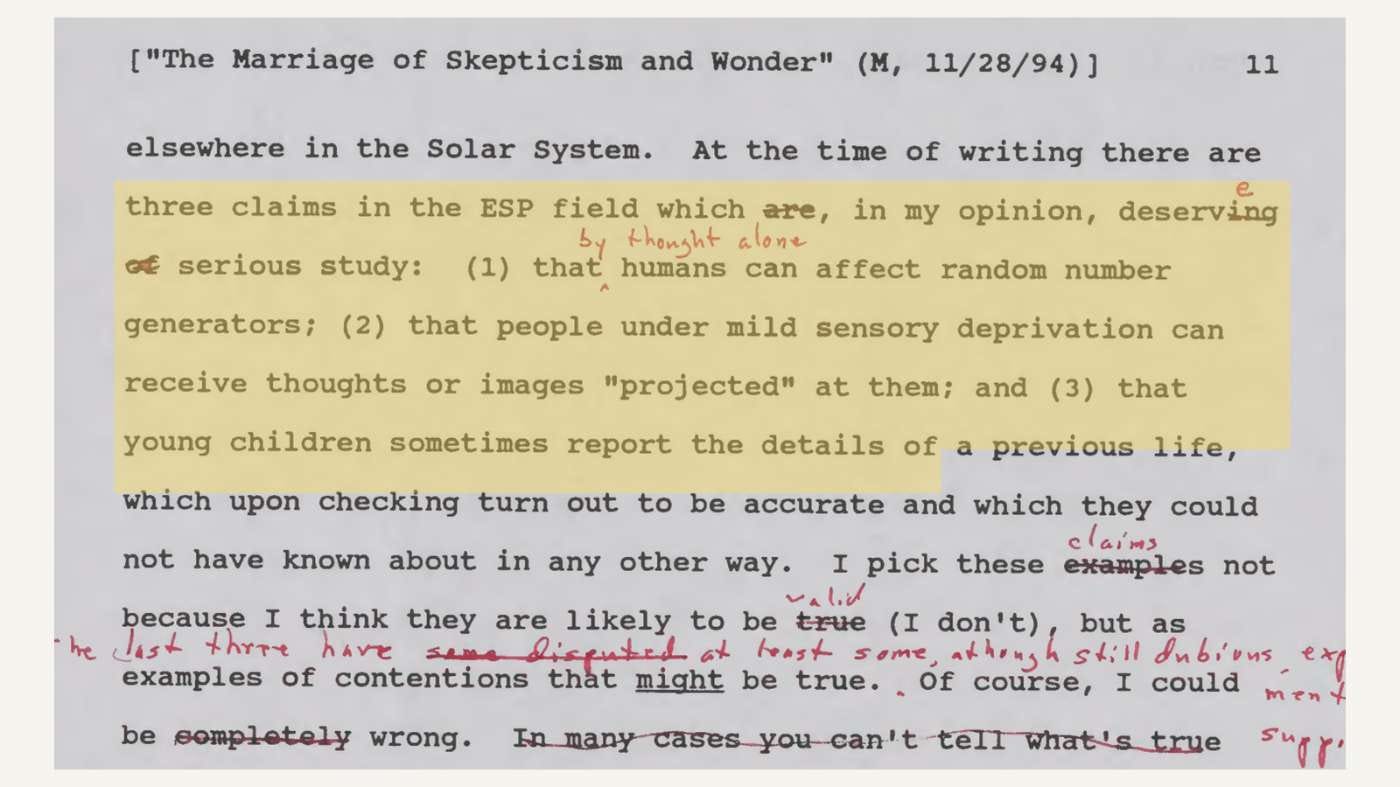
Context: The three claims involved small effects on random-number generators, projected images received under mild sensory deprivation, and young children who reported apparently checkable details of previous lives. Sagan first said that most paranormal claims lacked firm support and that these three had only “some, although still dubious, experimental support.” He was calling for controlled inquiry, not endorsing ESP or reincarnation.
Erwin Schrödinger
“Consciousness cannot be accounted for in physical terms. For consciousness is absolutely fundamental.”
Erwin Schrödinger, reported interview by J. W. N. Sullivan in The Observer, 11 January 1931; reprinted via The New York Times, 8 February 1931, and in Psychic Research 25, March 1931, p. 91.
“Consciousness is a singular of which the plural is unknown.”
Erwin Schrödinger, What Is Life?, Epilogue, Cambridge University Press, 1944, p. 89.
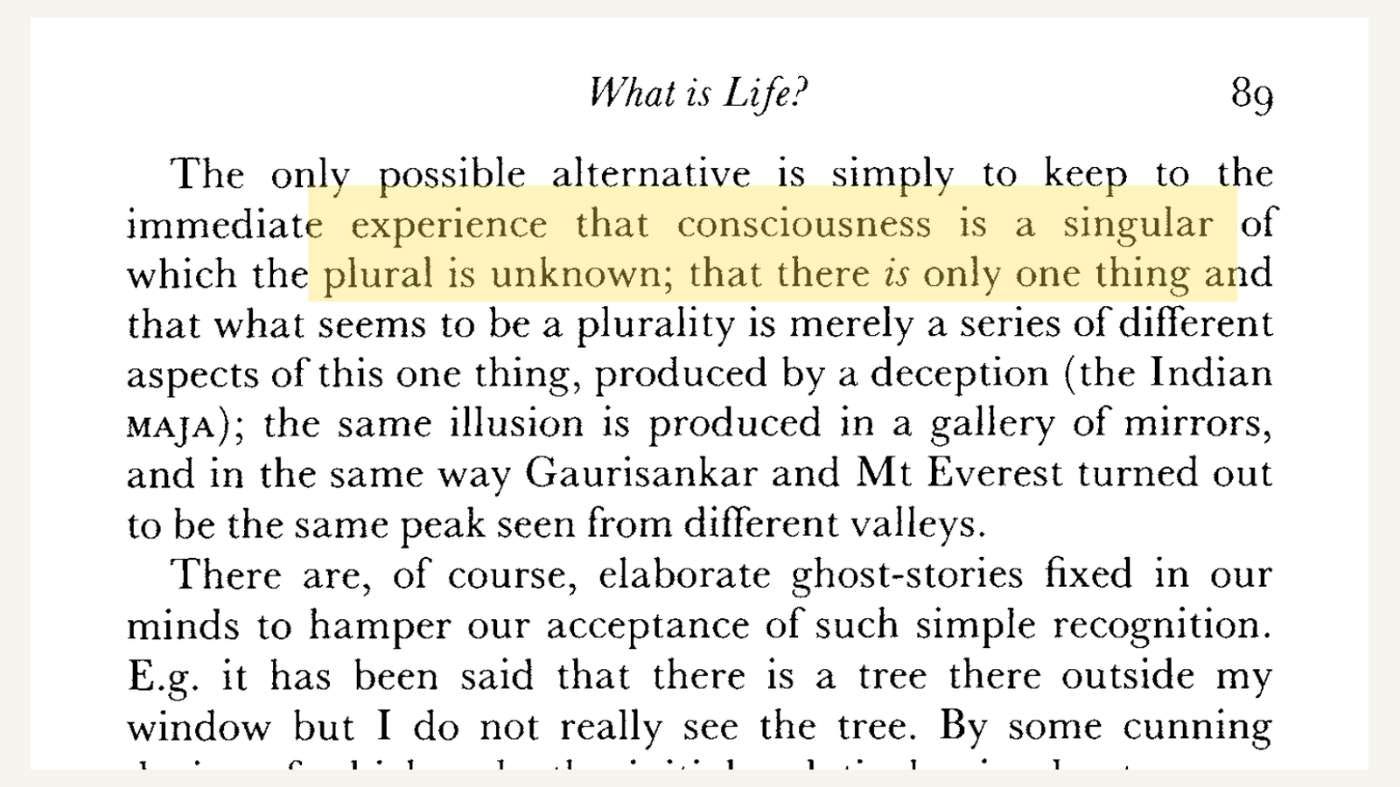
Context: Schrödinger’s mature metaphysics was influenced by Vedanta and treated the plurality of minds as appearance. This was a philosophical commitment, not a result derived from his wave equation.
John Searle
“From the fact that consciousness is entirely accounted for causally by neuron firings ... it does not follow that consciousness is nothing but neuron firings.”
John Searle, “Why I Am Not a Property Dualist”, Journal of Consciousness Studies 9, no. 12, 2002, pp. 57–64.
“The property dualist and I are in agreement that consciousness is ontologically irreducible.”
Searle, “Why I Am Not a Property Dualist.”
Context: Searle rejects both substance and property dualism. His biological naturalism says consciousness is caused by the brain while remaining ontologically irreducible to third-person descriptions.
Michael Shermer
“I have to admit, it rocked me back on my heels and shook my skepticism to its core as well.”
Michael Shermer, “Anomalous Events That Can Shake One’s Skepticism to the Core”, Scientific American 311, no. 4, October 2014, p. 97.
Context: A broken radio belonging to Shermer’s wife’s deceased grandfather unexpectedly played during their wedding, then stopped the next day. Shermer explicitly said the episode was not scientific evidence for survival or communication with the dead. It moved him and led him to recommend open-minded agnosticism about unresolved anomalies, without changing his evidential standard or becoming evidence for survival.
Alan Turing
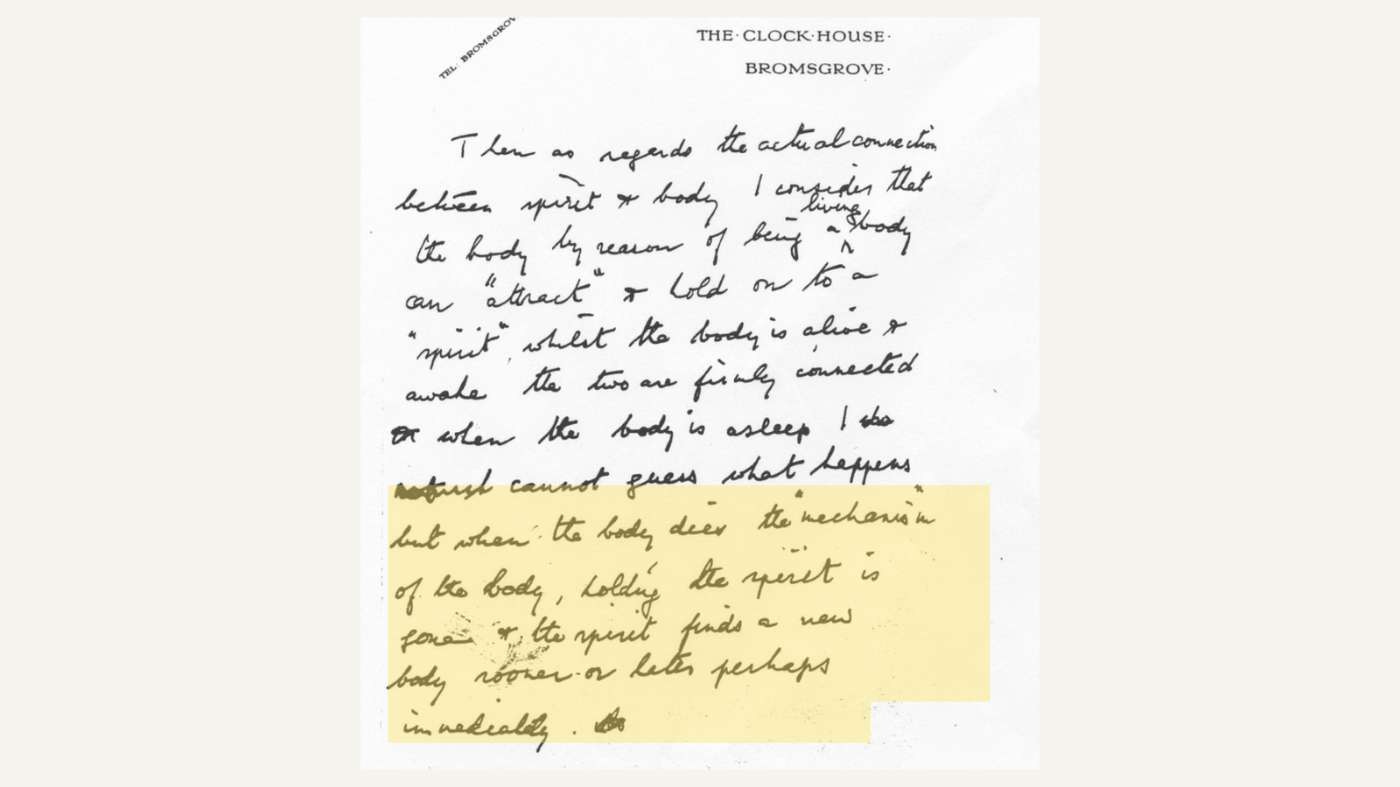
“When the body dies the ‘mechanism’ of the body, holding the spirit is gone and the spirit finds a new body sooner or later perhaps immediately.”
Alan Turing, “Nature of Spirit”, undated manuscript, c. April 1932; King’s College Cambridge Modern Archive, AMT/C/29.
“Unfortunately the statistical evidence, at least for telepathy, is overwhelming.”
Alan Turing, “Computing Machinery and Intelligence”, Mind 59, no. 236, 1950, pp. 453–454.
Accepting telepathy would mean that the idea of bodies moving only according to familiar physical laws “would be one of the first to go.”
Turing, “Computing Machinery and Intelligence,” pp. 453–454.
Context: Turing wrote “Nature of Spirit” at nineteen while grieving Christopher Morcom; it can’t be presented as his settled mature position. His later telepathy passage was serious enough to affect the design of his imitation game, but the experimental evidence that impressed him was subsequently discredited.
John von Neumann
“So long as there is the possibility of eternal damnation for nonbelievers it is more logical to be a believer at the end.”
Von Neumann’s deathbed reasoning as reconstructed by his biographer Norman Macrae, John von Neumann, Pantheon, 1992, p. 379.
“He was of course completely agnostic all his life, and then he suddenly turned Catholic. It doesn’t agree with anything whatsoever in his attitude, outlook and thinking when he was healthy.”
Oskar Morgenstern, quoted in Steve J. Heims, John von Neumann and Norbert Wiener, MIT Press, 1980.
Context: Baptized Catholic in 1930 for his marriage and agnostic in practice ever after, von Neumann asked for a priest, Father Anselm Strittmatter, as he was dying of cancer in 1957, and framed his return as a wager. No line here is in his own hand: the wager is his biographer’s reconstruction, and the report that the sacraments brought him no peace, that he stayed terrified of death to the end, comes from the priest who attended him as recorded by a later biographer, corroborated by Paul Halmos and Eugene Wigner. Morgenstern’s counter-testimony is kept beside it because the century’s most formidable logician reasoned his way to belief and, by every account, found no comfort there.
Alfred Russel Wallace
“It is ‘spirit alone that feels, and perceives, and thinks’; though, so long as the spirit is in the body, it does so by means of the brain and nervous system.”
Alfred Russel Wallace, letter to the editor, Light, 20 June 1896, p. 298.
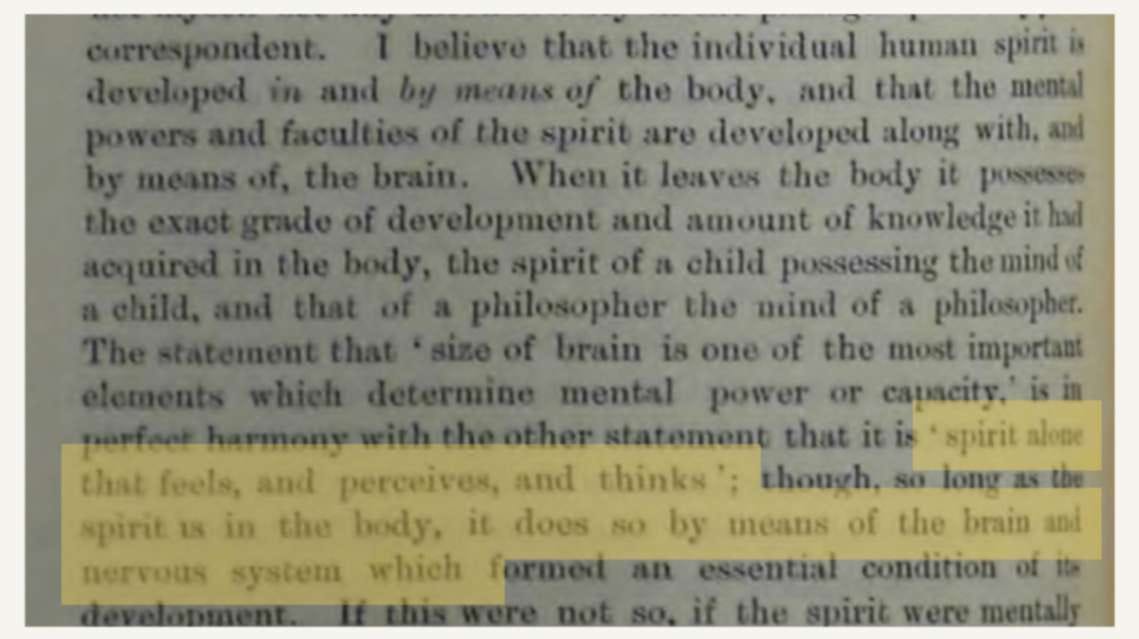
Context: The co-discoverer of natural selection became an outspoken spiritualist and argued that natural selection couldn’t fully explain the human mind. Darwin disagreed with him.
Eugene Wigner
“It was not possible to formulate the laws of quantum mechanics in a fully consistent way without reference to the consciousness.”
Eugene Wigner, “Remarks on the Mind-Body Question” (1961), in Symmetries and Reflections, Indiana University Press, 1967, p. 172; reprinted in John Wheeler and Wojciech Zurek, eds., Quantum Theory and Measurement, Princeton University Press, 1983, p. 169.
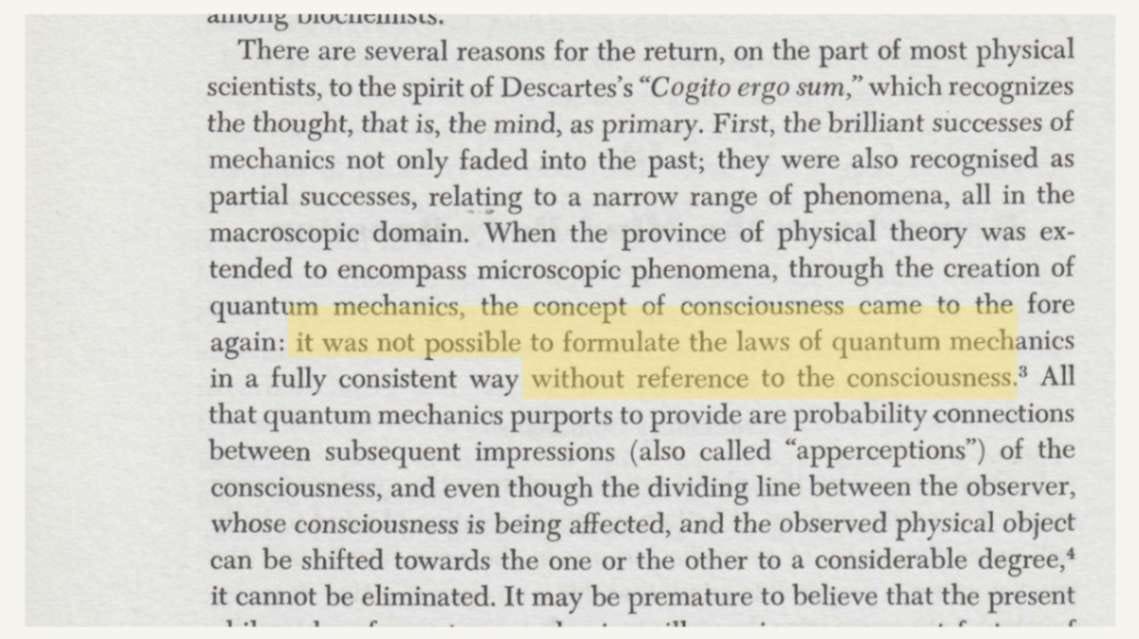
Context: This represents Wigner’s interpretation of measurement, not a theorem accepted by contemporary physics. He later moved away from treating consciousness as uniquely responsible for collapse, as Leslie Ballentine documented in “A Meeting with Wigner”.
Edward Witten
“I think consciousness will remain a mystery.”
Edward Witten, interview with Wim Kayzer, 1:10:29–1:12:20; transcribed by Ashutosh Jogalekar in Scientific American, 18 August 2016.
“I have a much easier time imagining how we understand the Big Bang than I have imagining how we can understand consciousness.”
Witten, interview with Wim Kayzer, 1:10:29–1:12:20.
Context: Witten expected biology and physics to explain much more about brain function. His pessimism concerned why consciousness accompanies that functioning, not whether neuroscience can progress.
Ludwig Wittgenstein
“I am not a religious man but I cannot help seeing every problem from a religious point of view.”
Maurice O’Connor Drury recalling Ludwig Wittgenstein, in Rush Rhees, ed., Recollections of Wittgenstein, Oxford University Press, 1984, p. 79.
“The Christian faith, as I see it, is a man’s refuge in this ultimate torment.”
Ludwig Wittgenstein, Culture and Value, ed. G. H. von Wright, trans. Peter Winch, Blackwell, 1980, p. 46, entry dated 1944.
“Religious faith and superstition are quite different. One of them results from fear and is a sort of false science. The other is a trusting.”
Wittgenstein, Culture and Value, p. 72, entry dated 1948.
Context: The first sentence is Drury’s recollection, with slightly different wording across editions. Wittgenstein’s notebooks contain belief, rejection, longing, and ambivalence. “Religious point of view” shouldn’t be converted into orthodox doctrine.
Sewall Wright
“Reality clearly consists primarily of streams of consciousness.”
Sewall Wright, “Panpsychism and Science”, in Mind in Nature, 1977.
“Emergence of mind from no mind at all is sheer magic.”
Wright, “Panpsychism and Science,” 1977.
Context: Wright was one of the principal architects of modern population genetics. He regarded panpsychism as philosophy rather than day-to-day biological method, but he defended it for most of his adult life.
None of this shows that an unusual view is true because a brilliant person held it. Nor is this a census. I went into this because I was inspired by the article here by Arthur Haswell...
Actually, the entries above point in incompatible directions. Some affirm God; others naturalize spirituality. Some defend mind beyond reduction. Some admit only an explanatory gap. Some accept paranormal claims. Of course, others reconsider and reject them.
I want to hear from you in the Substack comment section below. I read each and every response.
—Curt Jaimungal
PS: Consider becoming a paying member on this Substack. This is how I earn a living, as I’m directly reader-supported. Moreover, you’ll get a slew of exclusive content such as early access to full podcasts. If you like the free content, you’ll love the members-only content.
PPS: I read The Economist and find their coverage of science, AI, and global affairs genuinely excellent. If you’d like to try it, my link gets you a huge discount. They don’t partner with just any podcast. In fact, I believe TOE is the only podcast they consistently partner with, thus you get a special 35% discount not offered anywhere else.
It is very rare for me to encounter an English word that I have never heard before. Thanks for introducing me to 'eldritch'.
This is a great compilation. It's good to be reminded of the wide spectrum of views on a topic like this.