

This is a strange post
Whereof one cannot speak, thereof one must be silent


This is a strange post. How can I write about something that’s ineffable? How do you explicate the inexplicable? How do you tell the inenarrable?
The most meaningful aspects of life often can’t be put into words. At least not without heavily betraying and diminishing them.
For instance, when you attempt to report your own introspection aloud with words, it’s like grasping at liquid falling through your fingers. It’s something that appears solid, until you hold it. I’ve likened this to thixotropic fluids in physics.
But it’s unclear how much of this is an in-principle problem of language versus that we haven’t a refined enough language… (This is, of course, even putting aside the question of “what the heck is a language in the first place?!”… something I will write about shortly, so subscribe for that.)
Think about it like this… for literal millennia, no person could ever write down a solution to x² + 1 = 0. A mystic could have said, this is because “language is insufficient, you foolish plebeian.” But then some Italian mathematician eventually said “hold my beer.” As Italians do.
Turns out the solution was to explicate (widen, in this case) the language of real numbers until it had an i in it, forming the complex ones. From that point, not only did that single equation have a solution (two of them, actually), but even a rowdier crowd of notions once filed under “inexpressible” turned out to be waiting on vocabulary:
instantaneous velocity needed the invent of calculus,
“same size” for infinite sets waited on Cantor,
and what energy even is is still waiting on aisle 157…
Language does both transmitting and dredging. That is to say, it pulls the thought into being (both creation and excavation at once). Even so called untranslatable words are still just words in another language, strung together over a paragraph.
So then the question is, when someone declares something “ineffable” you can ask: ineffable in which language, and at what time?
And if it’s truly ineffable, how can we say anything about it at all, including asserting with words its own ineffability?
“Metalanguage” and the Residue
A language rich enough to talk about its own sentences can’t contain a truth predicate for itself. If it could, you could write the sentence that says of itself that it’s not true, and, under ordinary logic, the whole construction tips into contradiction (the Liar).
Alfred Tarski turned this into a theorem. He said, truth for a language L has to be defined in a metalanguage stronger than L. You can absolutely say which of L’s sentences are true. You just have to say it from another level. It’s like with my wife: the truth is upstairs, in a closet, muttered softly, but it’s still my fault that I didn’t hear.
So, to define truth for level one you ascend to level two; for level two, level three. You can keep going infinitely.
Each new “language” can now say some things that were unsayable below it. Furthermore, it has a fresh set of unsayable statements of its own. Much like some of the buildings here in Toronto, the penthouse is forever under construction.
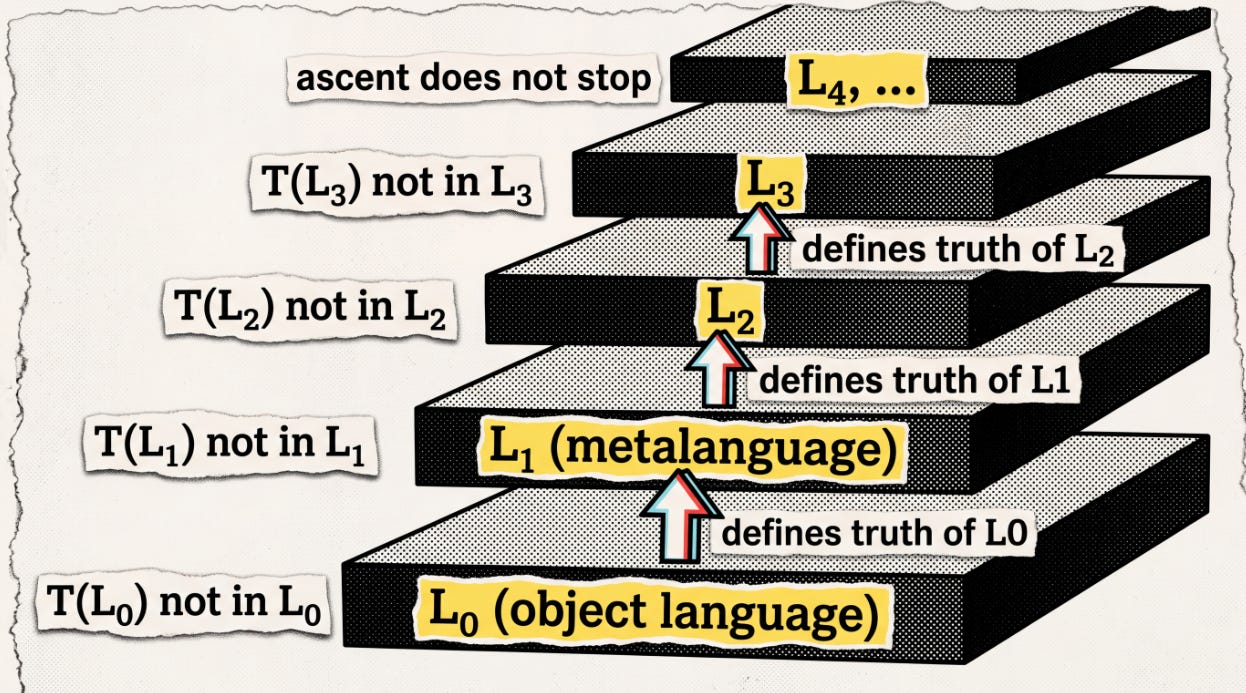
NOTE: The logician in me wants to object that you can indeed keep truth inside one language if you let some sentences be neither true nor false, or both at once. But then you can’t say, from inside, which sentences have that non-classical status without starting the same game again.
So while every particular sentence gets said, one floor up, what can not be done is to say all of it, from inside. I wonder how much of this is also one of the reasons we can’t truly know ourselves.
You can always step outside a given language but what you can’t do is step outside language as such, every level at once… Seemingly, at least…
Averted Vision: The Second Kind of Unsayable
There’s a second entry filed under the same word, but it’s a different sort of animal.
This is something I’m interested in for the book I’m writing for Penguin Press. This is the kind of phenomenon that destroys what it’s trying to explicate by the act of attending to it.
Some of these are perfectly sayable:
Attend to your own falling asleep and you’ll be awake (insomniac here, can confirm).
Explain why the joke is funny and the humor dies.
Focus on the actual riding of a bike and paradoxically you start to lose balance
Render the felt sense of a hard choice into a tidy list of reasons, and the “texture” that made it a choice is gone. Michael Polanyi studied how when we attend focally to what was doing its work in the background, often it stops working (we know more than we can tell).
A cousin of this, though a distinct one, is averted vision. Astronomers know this trick. A faint star vanishes when you stare straight at it, but it reappears when you look slightly to the side (the center of your eye is the wrong instrument for dim light).
I actually spoke about this with Janna Levin (and also on that lecture above for the Mind at Large conference). Here the star survives your stare, however, the head-on look fails. Some of the unsayable gets destroyed by attention, then, and some is merely missed by it.
Formalize love as mere oxytocin and you lose love-as-lived; formalize truth-in-a-language and you lose truth-in-that-language.
I can’t tell you the order of the letters on my keyboard, but my fingers type it at speed… (I don’t have it as declarative knowledge, yet my digits “know” the keyboard intimately)
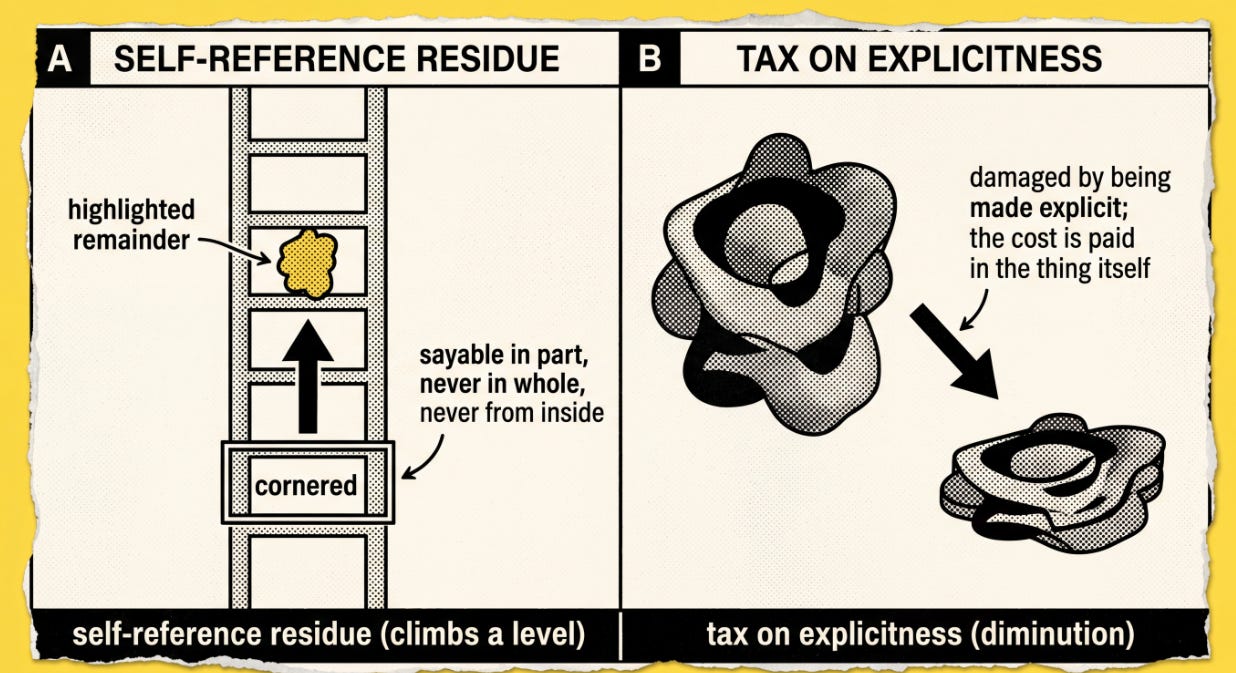
We start with the spirit of an idea, pull out something explicit (a definition, a metric), and then treat the extraction as the original. The spirit versus the text is God versus idol.
Goodhart’s law is one incarnation of this (to use a pun): the moment a measure becomes a target, it ceases to be a good measure. You can look up examples of this. Many are apocryphal (the Indian cobra bounty, for instance), but there are great, true historical accounts that should make you laugh (colonial Hanoi paid per severed rat tail, and the sewers were soon abound with unfortunate tailless rats).
The explicit version was supposed to serve the implicit one, and, given a title, it turns on its patron. I believe Iain McGilchrist’s left hemispheric usurpation to be an example of this general phenomenon.
Something I often think about is “what, precisely, gets destroyed when that phenomenon is turned into explicit symbols?” Almost all of my life has been spent taking phenomena and then routinizing them, making them rigorous via symbols (via making them serve symbolic manipulation). Physics not only allows this, but only allow this.
However, it doesn’t seem like all of what we call reality submits to this pattern. Indeed, much of what’s most important to us seems to directly subvert this pattern!
Where I Side With the Mystics
A theory of everything in the formal sense may turn out to be smaller than an account of Everything there is.
William James said there are some experiences that “defy expression.” Such states “must be directly experienced; it cannot be imparted or transferred to others.” It can’t be imparted whole, from within.
James heard that as words failing the mystic but it might just be the mystic being early. Why? Well, the fantasy that fails is the vantage point outside your own experience, and the mystics seem to have caught something quite before the logicians did. In fact, this happens more than you think. Washing hands tends to lead to stronger confessions.
As someone who petitions for precision by professional position, I also keep a place for mystery. James did as well. He said that if you lack the ear, you would rate the musician as “weak-minded or absurd,” and “the mystic finds that most of us accord to his experiences an equally incompetent treatment.”
James has so many golden quotes. Another is that “states of insight into depths of truth unplumbed by the discursive intellect”, carrying “a curious sense of authority for after-time.”
What was James’ conclusion?
That such states are authoritative for the person they come to (this is something you feel concretely on psychedelics) and that they demote the rationalistic consciousness to “only one kind of consciousness.” That demotion includes much of my adult life!
I think the problem may be idols. Favoring the “text,” if you will, over the “spirit”.
“The Tao that can be spoken is not the constant Tao” reads differently from this POV. The famous line is partly a translation artifact anyway: its second Dao is a verb, closer to walked than told. Laozi’s complaint, in my reading at least, targets idols rather than language. An idol is something like a frozen extract meant to represent something that moves.
Let’s take that verb seriously: what can’t be told can still be walked, and the traditions built disciplines of walking. Pseudo-Dionysius negated in a fixed order (coarse names first, refined ones last), then negated the negations, precisely so that no description would harden into an idol. Maimonides counted each disproof as a gain (“the more you can prove inapplicable to God, the better”). The Stanford Encyclopedia reports the training side plainly: “Meditative techniques promote a pronounced inhibition of ordinary cognitive processes,” which is averted vision phenomenon by another name.
Some of what matters may have to be investigated by walking the way mystics walked it. Potentially, with precision.
Look, all of this is super uncomfortable to write about.
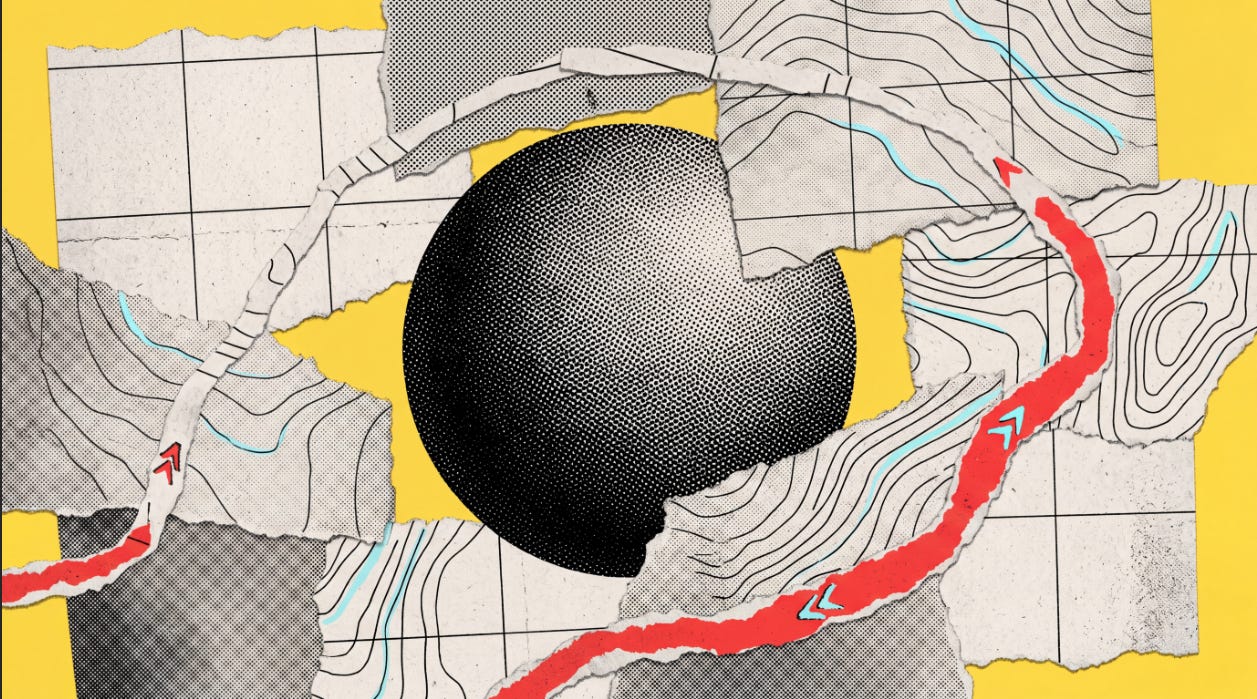
I’m writing about what you’re not supposed to be able to write about, and so it brings me on the edge of senseless. Abhay Ashtekar once told me that reality may be not coverable by a single chart. What he meant was that, if you take a look at a sphere, you technically can’t describe it with one “map.” You need at least two, to properly cover the space. The same goes for a simple circle.
The simplest of objects require more than one description. Why do we think something as potentially as complex as “reality” demands one sort of analysis to fully cover?
Next to Nietzsche, Wittgenstein is probably the most misunderstood philosopher. Many think of him as saying we should repudiate language. That our words are somehow execrable and insufficient. But words are tied to action. To the walking of the path. They aren’t only etchings on a paper for manipulation via formal rules. Furthermore, the ladder Wittgenstein throws away was necessary to get to the top where he throws it away to begin with!
“Whereof one cannot speak, thereof one must be silent.” I disagree. It sounds too much like “shut up and calculate” for my taste. You should be able to dissent and discuss. We don’t know what language is. We don’t know what “walking” means. We don’t know what meaning means. We don’t know much about anything, and we’re here left trying to make sense of a seemingly senseless world. So let’s do it.
—Curt Jaimungal
PS: Consider becoming a paying member on this Substack. This is how I earn a living, as I’m directly reader-supported. Moreover, you’ll get a slew of exclusive content such as early access to full podcasts. If you like the free content, you’ll love the members-only content.
PPS: I read The Economist and find their coverage of science, AI, and global affairs genuinely excellent. If you’d like to try it, my link gets you a huge discount. They don’t partner with just any podcast. In fact, I believe TOE is the only podcast they consistently partner with, thus you get a special 35% discount not offered anywhere else.
The “Unexpected Way” by Paul Williams explores the “mystical” depths we’re all orbiting, yet our trajectories often conflict and confuse us. Williams was Professor of Tibetan Philosophy and Head of Bristol’s Department of Theology and Religious Studies. His repudiation of the existential implications of Buddhism and shift in his worldview speak to a different mystical framework. It’s worth reading.
I absolutely agree with your infinite meta-language description. This is something Hilary Putnam missed, in my opinion, chalking it to “just more meta”, suspending the infinity of hierarchical generality. As for your “shut up and calculate” read of Wittgenstein, I laughed; that’s quite good. But with Wittgenstein, at least his Tractatus, I wonder if he really meant “shut up and observe/experiment” simply because he would have seen mathematics as a potential linguistic ladder to climb and then throw away after its use was exhausted / no longer meaningful.